The property market continues to improve with sales rising by 24% in April
By Bennecke Real Estate ·

The property market continues to improve with sales rising by 24% in April
The biggest increase for 2 years
 The Spanish property market is seeing a notable increase in sales.
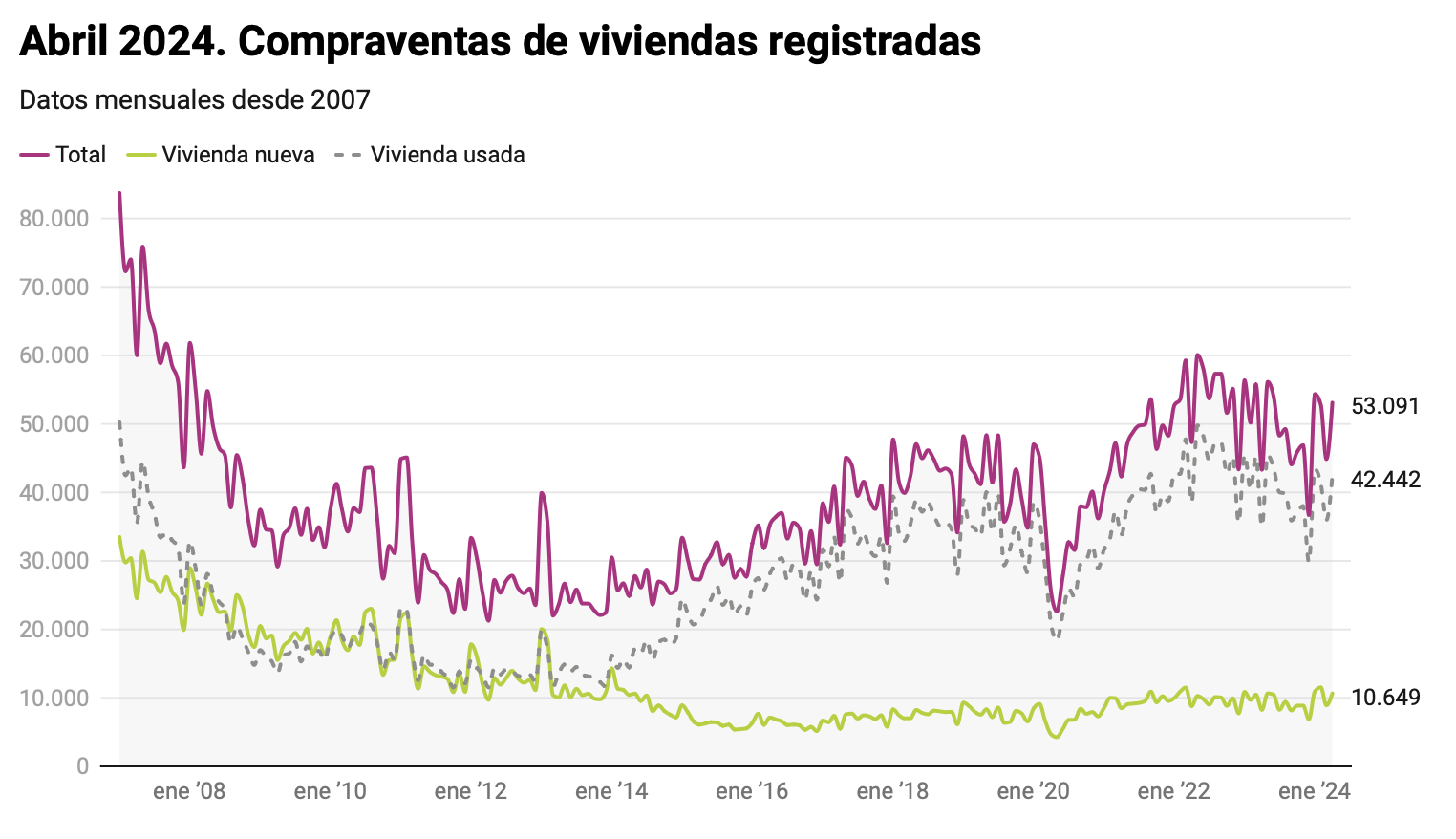
According to Spain’s National Statistics Institute (INE), in April, 53,091 transactions were registered across the country, the highest figure for the month of April since 2008. This is also 24% higher than the same month last year, representing the biggest interannual increase since May 2022, and similar trends are being observed across the country.
These figures mark a return to positive sales trends after a fall of 19.% in March, which was primarily due to Easter week. Annual figures also look encouraging so far. Between January and April, sales were up 0.6% compared to the same period in 2023. Sales of new-build homes in particular have increased by 9%, although sales of resale properties have fallen by 1.3%.
According to the INE, the increase in registered transactions is observed for both new-build homes, which are up 31.7% compared to the same period last year (10,649 transactions), and resale properties, which are up by 22.3% (42,442 transactions).
In April, 93.1% of property sales were related to private housing, while 6.9% concerned social housing. In total, sales of private properties increased by 25.6% compared to the same month last year (totalling 49,416 transactions) and social housing sales rose by 6.4% (3,675 transactions).
According to Francisco Iñareta, spokesman for Idealista, “As with the mortgage figures published yesterday, the high growth reported by the INE has a significant seasonal component due to the different dates of Easter week in 2023 and 2024. However, the number of transactions seems to have stabilised above 50,000 per month, which suggests the organic recovery of the market this year. While there isn’t currently enough supply on the market, if this trend continues, it is possible that sales volumes will stabilise over the next few months and we begin to see significant growth during the second half of the year.”
The Spanish property market is seeing a notable increase in sales.
According to Spain’s National Statistics Institute (INE), in April, 53,091 transactions were registered across the country, the highest figure for the month of April since 2008. This is also 24% higher than the same month last year, representing the biggest interannual increase since May 2022, and similar trends are being observed across the country.
These figures mark a return to positive sales trends after a fall of 19.% in March, which was primarily due to Easter week. Annual figures also look encouraging so far. Between January and April, sales were up 0.6% compared to the same period in 2023. Sales of new-build homes in particular have increased by 9%, although sales of resale properties have fallen by 1.3%.
According to the INE, the increase in registered transactions is observed for both new-build homes, which are up 31.7% compared to the same period last year (10,649 transactions), and resale properties, which are up by 22.3% (42,442 transactions).
In April, 93.1% of property sales were related to private housing, while 6.9% concerned social housing. In total, sales of private properties increased by 25.6% compared to the same month last year (totalling 49,416 transactions) and social housing sales rose by 6.4% (3,675 transactions).
According to Francisco Iñareta, spokesman for Idealista, “As with the mortgage figures published yesterday, the high growth reported by the INE has a significant seasonal component due to the different dates of Easter week in 2023 and 2024. However, the number of transactions seems to have stabilised above 50,000 per month, which suggests the organic recovery of the market this year. While there isn’t currently enough supply on the market, if this trend continues, it is possible that sales volumes will stabilise over the next few months and we begin to see significant growth during the second half of the year.”
Increase observed across Spain
This upturn in market activity has been observed in all of the country’s autonomous communities, although with some variation. The biggest increases in sales transactions have been seen in Castile-La Mancha (49.2%), Asturias (45%) and Aragon (44.5%), being the only regions with interannual growth above 40%. The figures for the Canary Islands (39.3%), Navarre (39%), Andalusia (33%), La Rioja (30.6%) and Galicia (26.7%) are all above the national average of 24%. The rest of the regions have also seen increases, but they are below the national average. The Valencian Community and the Balearic Islands have seen interannual growth reach 20%, while Murcia and Castile and Leon have observed an increase of 19%. The most moderate growth figures have been in the autonomous communities of Cantabria (17.4%), Catalonia (16.6%), the Basque Country (15%), Extremadura (1.2%) and Madrid (6.1%), with the latter two being the only regions to register single-digit increases. Source: IdealistaLooking for a home on the Costa Blanca?
Bennecke Real Estate has helped buyers in Torrevieja, Alicante and across the Costa Blanca since 1988.
View properties Talk to an adviser